From structured master data to usable digital twins

How D&TS and Neoception transform your product data into real business value
Many companies talk about digital twins.
Few have the structured database to make them economically viable.
Unclear attributes, inconsistent naming, and a lack of standardization often prevent scalable implementation. Digital initiatives remain pilot projects because the semantic basis is missing.
This is exactly where the partnership between D&TS and Neoception comes in
We combine data quality and classification with scalable AAS technology. The result is an end-to-end solution from raw data sets to an operational, usable Asset Administration Shell.
The core problem: data is available, but unusable
Industrial companies already have extensive product data in ERP systems, PIm solutions, Excel files, or technical documentation.
However, this data is often:
- not standardized
- not interoperable
- not AAS-capable
- not consistently structured
Digital twins rarely fail because of the technology. They fail because of data quality.
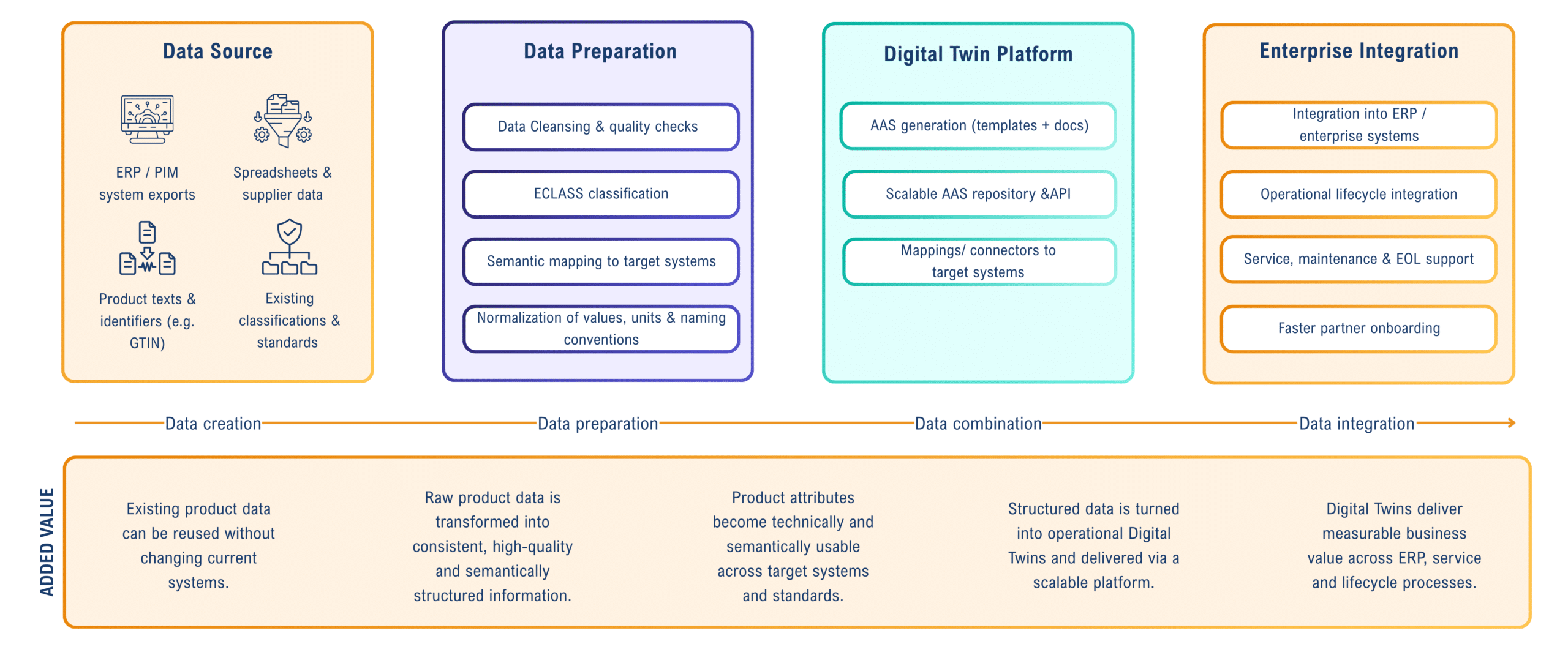
The end-to-end process from data source to AAS
How can existing material data be automatically converted into interoperable digital twins? The following process diagram shows the joint approach taken by D&TS and Neoception.
Further information on the Asset Administration Shell and its possible applications in industrial digitalization projects can be found on our topic page on the administration shell
Automated material data instead of manual maintenance
In many companies, the creation and maintenance of material master data still involves a great deal of manual effort. Information from different sources must be collated, reconciled, and regularly updated. This process can be significantly simplified through a standardized semantic basis and automated AAS generation. ECLASS provides the uniform classification. D&TS structures and quality-assures the material master data. Neoception automatically transfers this data into interoperable digital twins in the form of Asset Administration Shells. The result is reduced process costs, consistent material data across system boundariesm and a robust basis for digital value creation.
The technical contacts for this topic are Adrian Grüner at Neoception and Sebastian Böttjer at D&TS.
The following video illustrates the process described and shows how structured ECLASS data is automatically converted into standardized digital twins. Unfortunately, this video is only available in German.
Why our partnership is relevant to you
D&TS stands for data quality, classification, and semantic structure.
Neoception stands for platform technology, AAS generation, and system integration.
Together, we cover the entire process, from data origin to the interoperable provision of standardized digital twins. Companies benefit from clear responsibilities, a consistent architecture, and a scalable solution without interface losses between expertise and technology.
Digital twins are thus not only created technically, but also made economically usable.
Your next step toward a scalable digital twin strategy
The key question is not whether digital twins are relevant. The crucial question is whether your existing product data already has the necessary structure and quality.
If you would like to check how AAS-compatible your material data is today, where specific quality gaps exist, and how ECLASS-based structures can be optimally transferred to a scalable digital twin architecture, we would be happy to discuss this with you.
In a joint discussion, we will analyze your initial situation and identify specific areas for action and measurable potential for your company.
Related blog posts from D&TS
UNSPSC Classification Using AI: How True Procurement Transparency Is Achieved
Learn more